Skip to content
← All blueprints
Wholesale Hub

B2B Wholesale Order Portal

Wholesale Hub

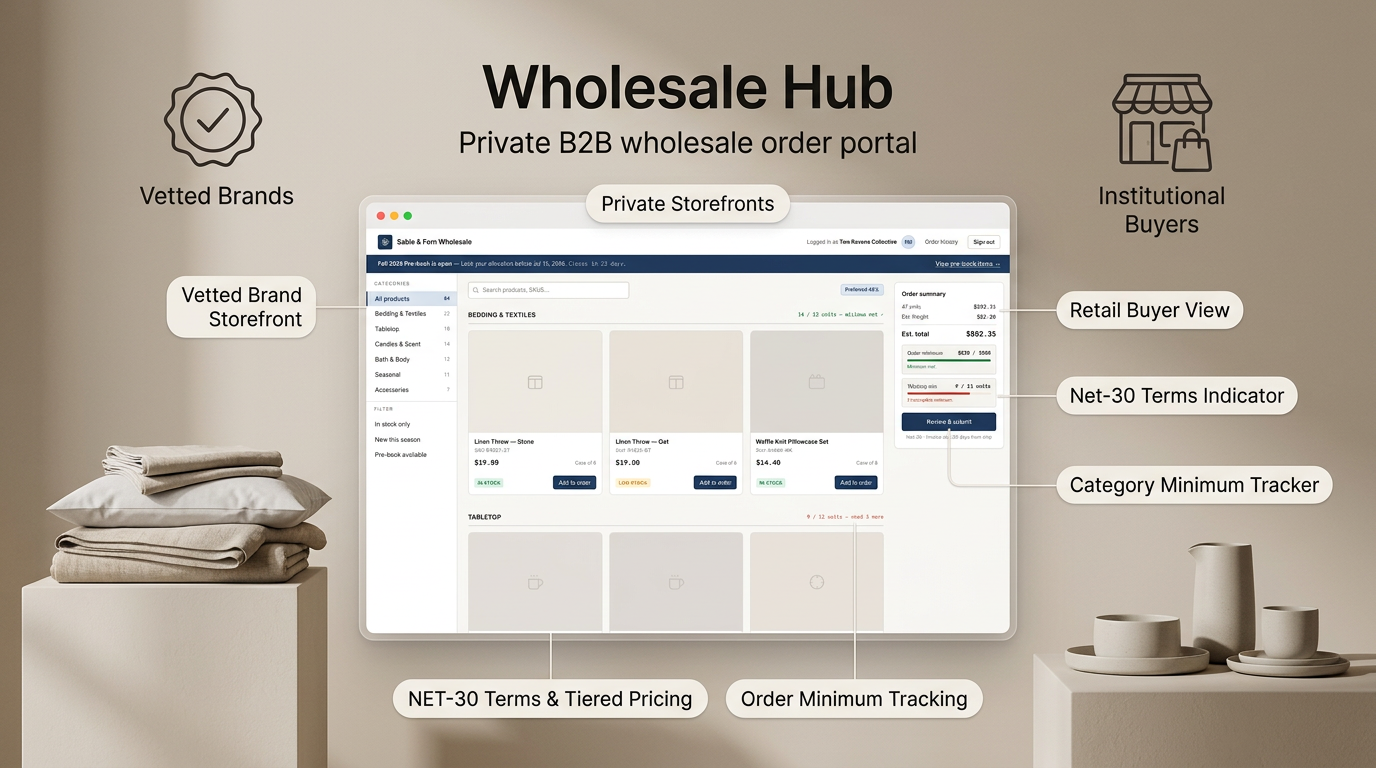
A private B2B order portal where brands open vetted storefronts to retail buyers with tiered pricing, order minimums, and net-30 terms.

  • Full planning bundle — BRAND, MRD, BRD, PRD, DESIGN
  • Branded styleguide — typography, color, components
  • 5 previewable mockups

Cloning copies the full plan into a new project you own — edit it freely.

Inside the bundle

Styleguide and mockups

A look at the brand palette and screen-level mockups that ship with this plan. Cloning copies all of them into your project.

Style guide

Styleguide

What this blueprint gives you

A production-grade wholesale ordering system — the private trade channel brands open alongside their DTC store to sell direct to boutiques, retailers, and distributors at tiered pricing with enforceable minimums and credit terms.

Buyers arrive by invitation or application, browse a catalog filtered to their approved price tier, build orders in a spreadsheet-grade order builder, and submit against net-30 or prepay terms. Brands see every open order, approve new accounts, manage price ladders, and track outstanding receivables from a single brand studio.

The buyer experience

Retail buyers log in to a catalog scoped to their tier — the MAP-protected unit prices, the case-pack constraints, and the seasonal availability they negotiated. Orders build like a purchase order: SKUs, variants, quantities, and a running total that updates with volume discounts as the cart grows. Reorder is one click: last order pre-populates, adjusted for current stock.

The brand-side studio

Brand managers configure price tiers (Keystone, Preferred, Distributor), assign buyers to tiers, set category minimums, and write the terms each buyer signs before their first order. Every application, approval, and outstanding invoice is tracked in one place without a spreadsheet.

Terms and credit workflow

Net-30 applications are reviewed inside the platform. Buyers upload trade references; brand managers approve, set credit limits, and mark invoices paid. Buyers who hit their credit ceiling cannot submit a new order until a prior invoice clears — the system enforces it automatically.

Reorder and relationship continuity

The reorder screen shows each buyer’s last five orders, their average basket, and any SKUs that are back-ordered. One-tap reorder pre-fills the builder with the previous quantities; the buyer adjusts and submits. Seasonal pre-book windows appear as a banner so buyers can lock allocation before production closes.

Five planning documents at senior-team depth

BRAND, MRD, BRD, PRD, and DESIGN cover buyer vetting, price-tier architecture, net-30 credit-limit enforcement, reorder cadence, brand-studio configuration, and the data model behind a multi-buyer catalog — everything needed to scope, design, and build this product from the ground up.

Planning documents

Preview the plan

Each blueprint includes the senior-level planning files. These cards show the opening text before you clone the full bundle.

Brand Guidelines Document

BRAND.md

Preview

BRAND — Wholesale Hub One line The wholesale channel built like a tool, not a portal — for brands that want buyers to order, not guess. Who it speaks to The brand manager. She runs wholesale for a DTC brand doing $3M–$15M in direct revenue. The brand opened a wholesale channel two years ago to reach independent boutiques, and it's now 25% of revenue — managed out of a Google Sheet, a shared email inbox, and a Stripe link. She knows the SKUs, knows which buyers she trusts on net 30, and knows whi

Design Specification Document

DESIGN.md

Preview

DESIGN — Wholesale Hub Design intent Two primary surfaces, one visual language. The buyer catalog is the brand's trade showroom — the brand's logo, name, and colors are forward; the platform's chrome is minimal. The brand studio is an operational workspace for the brand manager — dense, accurate, no decorative padding. Both surfaces share a type scale, table grammar, and status color system; neither surface looks like a consumer app. The dominant register is business formal: ivory white canvas,

Market Requirements Document

MRD.md

Preview

MRD — Wholesale Hub Market summary Independent brands doing $1M–$25M in direct to consumer revenue have a wholesale channel problem: the demand is real, the accounts are there, but the infrastructure is a pile of workarounds — spreadsheets, email threads, a custom Shopify B2B setup that broke the retail store, or a legacy EDI platform that costs $2k/month and requires IT support to configure a new buyer. The wholesale software market segments into two bands: enterprise EDI/ERP tooling (SPS Comme

Business Requirements Document

BRD.md

Preview

BRD — Wholesale Hub Business model A pure SaaS subscription with no transaction margin. Brands pay a monthly or annual fee; the platform does not take a percentage of order value. This is the primary commercial distinction from marketplace first competitors (Faire, NuOrder) and the main reason brands with established buyer books switch. Optional add on: an embedded net 30 financing integration where the brand can offer buyers financed terms through a third party factor. The platform earns a refe

Product Requirements Document

PRD.md

Preview

PRD — Wholesale Hub Product summary A private B2B order portal. Brands configure a tiered pricing catalog, set order minimums, manage buyer accounts with net 30 credit terms, and receive self serve purchase orders from vetted retail buyers. Buyers browse a catalog scoped to their price tier, build orders against minimums, and reorder in one tap. Personas Maya, wholesale manager at Sable & Fern (a home goods brand, $6M DTC). Manages 45 active wholesale accounts. Sends a Google Sheets price list u

Keyboard shortcuts

Press ? anywhere to open this list. Esc closes it.

Go to dashboard
g d
Go to current project
g p
Save the editor
S
Send chat message
Open this cheat sheet
?

Sequence shortcuts (g _) only fire when no field is focused. On macOS use ; on other platforms Ctrl.